Showing posts with label 10/10. Show all posts

20 May 2009

@bobbyperublog

...

bobbyperu came up for air

...

All right, here I am again.
But.
Before opening champagne I'd like to inform you that my return is a one-timer - at least for a while for sure.
But.

I have also good news for you: bobbyperu will haunt you on a new platform! You know: the twitter™ is the new blog, so it's time to listen to the geek winds, and follow me, moreover follow me on my twitter site (if you haven't got twitter account yet, you can create one here within no time).


From now on you'll receive tips and remarks, questions and answers, ideas and theories, evaluations and devaluations, etc. ... Thus you don't have to read my pretentious film or scene analyses but only the pure facts which might help you to decide: should I watch the particular film or shouldn't. So simple. Only 140 characters, I'll blow my mind!


Now it's champagne-time!

10/10

05 November 2008

North by Northwest (1959)

Yesterday I decided to rewatch one of my favorite films – it seems nowadays I spend more attention on movies which I've seen before. This tendency might have different reasons, for example my disappointment in contemporary films (recently: Tropic Thunder, 2008 (ok, I searched the problem for myself...)), or simply because I'm getting old:)

Anyway, just as yesterday, since you know everything about Hitch's masterpiece already (there are far better articles about it than the one I could provide here), I won't offer you a boring review, but a funny goof.

Please note the small boy in the scene's background:


The simple story goes like the scene required many reshooting, so the boy might have been scared/fedup with the coming gunshot's loudness. But don't blame the director: in 1959 nobody predicted the technical development of the future where crazy cinephiles have a chance to watch every details in slow motion (see the truck's explosion and Cary Grant's puppet under the vehicle:) Even more mostly minor goofs on NbNW are here).

10/10

04 November 2008

Touch of Evil (1958)

I don't want to bother you with the 3212405th review of Welles' unbelievable perfect classic noir – here I'd like to talk only about the famous opening scene, the illustrious long take (I had to watch it again after it was honourly mentioned in the even more precisely planned opening (...long) scene of Altman's The Player).

Nothing's new with it, what happened is that yesterday I checked how long is exactly the run of the camera. But first let me give immediately a remark with the help of David Bordwell: ""long take" is not the same as "long shot"; the latter term refers to the apparent distance between camera and object. (...) a take is one run of the camera that records a single shot" (Bordwell: Film Art: An Introduction, 1997, 259). Flaherty's Nanook of the North (1922), Welles' Citizen Kane (1941), more recently Joe Wright's Atonement's Dunkirk scene (2007), or the often cited, visually tricky last scene of Antonioni's Professione: reporter (The Passenger, 1975) are the classic examples for the use of the long take without montage. You know them very well. (Here I don't want to mention the difference between the long shot and the tracking shot – which is rather obvious.. On the other hand I believe it's unnecessary to know all the existing cinematographic terms – since they vary in different books, it's much better to understand only how they cue emotions...)

So how Touch of Evil's first long take looks like? Fact: the camera follows the ride of a bomb from its detonator's set until its explosion, so it rolls 3 minutes and 20 seconds without a single cut. It's definitely not a world record, which is more interesting is that the villain who starts the bomb ticking (notice Henry Mancini's bomb-ticking score!) sets the detonator around 3:20 too (as far as we can see that clearly).


And here is the entire scene:


One could argue about the difference between its felt and real time – I would say with the Hitchcockian planted suspense (see below ) I felt the situation much longer than 3:20 (The same happens – without any suspense at all – during Béla Tarr's uunnbbeelliieevvaabbllee ssslllooowww opening take in Sátántangó (Satan's Tango, 1994)). No more words on this since this post is not about the psychological-cognitive differences of the perceived time.

More important is to watch Uncle Joe Grandi's (and Hank Quinlan's, whose "intentions", "hunches" are just painfully, even suspiciously right...) plan which is – as the film's ad says "one of the strangest vengeance ever", but which is the darkest noir for me.

"A real sweet setup."

10/10

 “There is a distinct difference between “suspense” and “surprise”, and yet many pictures continually confuse the two. I’ll explain what I mean. We are now having a very innocent little chat. Let us suppose that there is a bomb underneath this table between us. Nothing happens, and then all of a sudden, »Boom!« There is an explosion. The public is surprised, but prior to this surprise, it has seen an absolutely ordinary scene, of no special consequence. Now, let us take a suspense situation. The bomb is underneath the table and the public knows it, probably because they have seen the anarchist place it there. The public is aware that the bomb is going to explode at one o’clock and there is a clock in the decor. The public can see that it is a quarter to one. In these conditions this same innocuous conversation becomes fascinating because the public is participating in the scene. The audience is longing to warn the characters on the screen: »You shouldn’t be talking about such trivial matters. There’s a bomb beneath you and it’s about to explode!« In the first case we have given the public fifteen seconds of surprise at the moment of the explosion. In the second we have provided them with fifteen minutes of suspense. The conclusion is that whenever possible the public must be informed. Except when the surprise is a twist, that is, when the unexpected ending is, in itself, the highlight of the story” (Truffaut's interview with Hitchcock, 1984, 73).

02 November 2008

Rear Window (1954)

Instead of writing a traditional review about one of the best movies ever, here is a 5 (and a half) minutes long summary of Alfred Hitchcock's amazing cinematic classic from 1954 (the voiceover comes partly from the Wikipedia's plot summary). 
I hope you'll enjoy as much as I did during compiling it.


If the last weekend was a lazy one what should I say about this one? I mean maybe I've found a new way to ruin the whole weekend. At least I've got to know the very basics of a Final Cut Express 4 editing software.

Ok, a small amount of "brightness" at the end: Hopefully you recognized the moving images among the stills (not about the ones with the Ken Burns effect, but the "real" moving images). I didn't plan to edit them at the beginning, but since I realized how statically constructed even the moving ones, I decided to use them. I believe that this aspect of the statical viewpoints is less researched in line of the film's analyses. At least in the reviews this wise cinematic feature owes less attention than the POV's, alias Jeffries' dramaturgical staticality accompanied by the camera.

(Let's not start sentences with an 'if', so involve it to your sentences like) if I could restart my cinema-interested career, I would definitely study editing!

10/10
(but what is your grade?)

30 October 2008

The Player (1992)

The phrase of the day by June Gudmundsdottir alias Greta Scacchi from another Altman movie, The Player (watch it, 10/10) is the following (the question asked by Griffin Mill, a screen writing executive in trouble... (Tim Robbins)):


"Do you like books?"

"I like words and letters. But I'm not crazy about complete sentences."


Just think for a sec about how this answer describes Altman's storytelling. The Player isn't a network narrative (his classic, let's say prototype one definitely is – which comes one (1!) year later than this...), but the way how it smoothly interconnects all the paths and characters of the story (I'm thinking on the endless camera movements going in and out of rooms and separate spatial zones, plus the unique way of intercutting and overlapping the several parallel patterns of conversations) is already shows and advances how he will soon master the seemingly spreading storylines. 

I've never been interested in these complicated narratives' compact and smooth solutions – usually the perfectly worked off loose ends sacrifice other qualities of the film. Makes from the well established and pronounced letters and words a simple, syntactically valid but semantically unimpressive sentence. (It would deserve another entry, but I mention only here Matteo Garrone's superhot Gomorra (2008), where the paths of the network narrative deliberately avoid to draw a coherent narrative picture (to fulfill its aim is to depict the maffia's lost hierarchical and organizational order, to narratively emphasize the ongoing chaos...)).

If you don't care about storytelling you might still be interested in embedded stories, more precise the always exciting exercises of a film-in-a-film plot. Almost like two days ago...

10/10

28 October 2008

Sherlock Jr. (1924)

Don't need to introduce the genious Buster "Stone Face" Keaton. On the other day Tarsem's The Fall took a liking for watching an early stunt film (if you've seen the picturesque ode of early Hollywood's stuntmanship you understand my choice..). Usually we praise these films because of their reckless physical features. Although Keaton's Sherlock Jr. is full with these actions it is still more than a "simple" stunt film. It's packed with brain too. I could point to the embedded story of a wannabe projectionist as a detective and all the related tricks (this early example of a 'film in a film' character is – not a wonder – the movie's most cited value), but this time I'd like to indicate only one attraction / trick / gag from the film. What do you think about the jump at 1:59?


I told you – Keaton is without doubt "the" stuntman, but he is a magician too from Harry Houdini's finest school (Keaton remembers as Houdini gave his 'Buster' name to him, but it's more likely that his producers advertised him through the already famous Houdini (fact, that they were working together (Keaton grew up in a vaudeville family (although the story could continue I won't open more parentheses))))...

Without any special lighthearted feelings for the silent era, this 44 minutes is definitely 10 out of 10! Keaton's Sherlock Jr. comprises more cinematic and comedic ideas than half of contemporary Hollywood has. And this isn't a joke. Try to enjoy stone faced.

10/10

(Hey, what about yesterday's questions? One of them is within the best ever made 25 films – according the imdb...)

10 May 2008

The Roaring Twenties (1939)

"Bitter or sweet, most memories become precious as the years move on. This film is a memory – and I am grateful."

As the signature tells these lines are Mark Hellinger's words. But who is he? Good question, because Raoul Walsh didn't deal a card for him in his classic gangster masterpiece, The Roaring Twenties. Instead of taking part, Hellinger created the story, but he was more than a simple screenplay writer. He was one of the first Broadway columnists, a classic hard-drinking, hard-living theatre-journalist, with such a friends like Bugsy Siegel, Al Capone, Lucky Luciano and who knows who else. He was authentic.

"In this film, the characters are composites of people I knew, and the situations are those that actually occured."

And Walsh, my favourite gangster film director (with the unbeateable White Heat, exactly ten years after this) delivers the reality what Hellinger imagined, more precisely what he lived through. In the first minutes the wheel of time counts back twenty years from 1938. We found ourselves in a not so shiny April in France. During the WWI our protagonists meet in a bombshell in the middle of a war scene. They are Lloyd the heart of oak lawyer, George the savage guy from a "saloon business" (Bogie again, again, again, and again), and there is Eddie Bartlett, a simple guy from one of the garages of New York (Cagney is perfect as usual). 1919. The war is over, and our heroes return home, to find again their dropped lifes. But when the new decade, the roaring twenties start, they have to continue their well-known game, "the struggle for survive." Unemployment, taxes on the ceiling, prohibition, regression. The almost forgotten veterans are not as welcomed as they thought (familiar?). Everybody needs to find his new role in the changed circumstances, so their lifes starts from different tracks, but in such a perfect screenplay like this we can bet that they will cross each other's paths pretty soon. More than they ever wanted...

The 'roaring twenties' is rather a phrase than a reference to this classic piece to describe the exceptionally hectic decade. There are better and worse explanation about its cultural-, economic-, crime- and politics related historical moment, but if you are tired to study those, this film is a really good choice to seize all its knowledge embedded into a flawless story (Walsh carefully builds the history in the background).

As I said only the screenplay would deserve already 10 out of 10. Cagney's play (he is THE gangster) is the cherry on the top (is it possible that he is a mixture of Robbie Williams and Malcolm McDowell?:)!


!!!SPOILER!!!
Did you realize that in the 30's films Cagney always kills Bogart?

Hellinger had right: "This film is a memory – and I am grateful." Me too!

10/10

06 May 2008

Chinatown (1974)

"You're dumber than you think I think you are."

There are thousand definitions of being classic, but for me definitely is the case when I have time to time the feeling to rewatch the same film. Polanski's Chinatown is one of them. A true neo noir masterpiece. Why 'neo' is this noir? I could find thousand reasons, just think on its brave colours (a colorful noir? Yes!), its sexual taboos (hmm, maybe I won't spoil..), its femme fatale's human touch (which makes her story even more tragic). On the other hand it follows all the real noirs' rules with its slow ventillators, venetian blinds, complicated / layered storyline, dense cigarette smoke, sweating foreheads, heroes with accused past, soft hats and white rounded car tyres, where the sneaking in score of Jerry Goldsmith during the credits makes you goose bumps already (It would deserve a separate essay how the tone and the variations of the main theme of the music is changing along our way descending the deepest darkness of the story).

We are somewhere in the 1930's Los Angeles. Jake Gittes, a Marlow-type private eye, who changed a big part from his ancestor's cynism for some blasé attribute (I told you, it's 'neo' already, right after the fatal Vietnam war mixed with Gittes' diegetic dark secret back to his past in Chinatown...) has a new case: Mrs. Mulwray hires him to check her husband who in her opinion is having a lover. An important detail: Mr. Mulwray is a chief engineer of a huge L.A. project "Water and Power." The Alto Vallejo plan is about to solve the water problem of the city ("to keep the desert out from the streets and not on the top of them"). Simple case for the coony Gittes (he defines this extra of his as a "finesse"), he has the next days already compromitted pictures from the "couple" (even the newspaper gets them somehow...:). But the happines doesn't last too long: the next day Mrs. Mulwray is waiting for Gittis at his office with her lawyer. I mean the the never seen before, real Mrs. Mulwray (Faye Dunaway).

And we are only at the very beginning of it – after some murders happen Gittes gets another assignment, even from the real Evelyn Cross Mulwray. One more character needs to be introduced namely Evelyn's father, Mulwray's business partner in planning, Noah Cross (played by unbelievable complex John Huston, exactly, the film director), who is most likely behind all the mysterious and more and more deadly actions. He gives another assignment for the getting confused but more and more motivated (and involved) Gittes. And I didn't mentioned Polanski's cameo as a "midget" with a knife. Hilariously dangerous with his childish face...

"- May I speak frankly, Mrs. Mulwray?"
- You may if you can, Mr. Gittes."


Of course I won't forget to emphasize Jack Nicholson's figure as Gittes. But I have to say if I would write here a whole litany about his greatness it wouldn't be enough to express his qualities. Some might say that this is his career's main character, which according to his Jack Torrance or McMurphy is rather a brave statement, but I'm not sure if it isn't true.

If we are really talking about a classic film historical masterwork (as we are doing), there must be thousand small stories, gossips, legends around its cultic presence. Next to those I'd like to add my small proud-detail which was mentioned among the extras of the DVD: the novel's and the film's title as Chinatown comes from a Hungarian fellow who was working there and told stories about its strange world to the writer of the original story (Robert Towne).

To make it simple all the enthusiastic gibberish above: Perfect and obligatory.

10/10

15 April 2008

Charlie Chan's Secret (1936)

"Necessity - mother of invention.
But sometimes stepmother of deception."

You certainly love or hate Charlie Chan's figure (created by Earl Derr Biggers, played (this time) by Warner Oland), the Chinese detective, who used to tiresomely repeat these laconic sentences of dubious wisdom, who is sometimes wearing a terrible white suit, and who is using limited English with a bad, but characteristic pronunciation. Maybe in the real world I would like to hit him on his small moustached face, but actually in a movie like the whole series around his investigations he is a private eye full with individual virtue.

This time (Charlie Chan's Secret by Gordon Wiles) the film starts with a headline of a special edition of a newspaper: "S.S. Nestor lost in storm off Hawaii!" The rescue is going on already, because many prominent persons among missing. And just like it used to be, there is something "fishy" around the whole case: "A man walks out on a fortune seven years ago. Then all of a sudden, he appears from nowhere to claim it." The man's name is Allen Colby, and from the passanger list of the sunken ship he is the only one who is missing. He maybe disappeard in the deepest dephts of the ocean, but nobody could say that he died. Charlie Chan won't for sure... 

There is something common between the film professor David Bordwell and me: Charlie Chan's movies were one of our favourites during our childhood. Maybe he had luck to see them in some local movie theatre while I enjoyed some from the television. If you're regularly watching and analyzing films it isn't a surprise thet you've been amazed with these films: following Chan's methods, trying to find out his Columbo-like tricky logic, being interested in the wisely told and unfolded crime shows similarities with our everyday's interpretative methods like collecting small pieces of informations from images amd sequences, trying to look at the given narrative from different points of view, approach from parallel perspectives, build up hypotheses, summarizing existing knowledges. Actually Charlie Chan's stories contain all the values how we like and read movies.


Even if it's a bit overacted (there is a living ghost of a silent cinema in the air), even Chan's irritating character (after a while you will like him more and more) ten out of ten without a single doubt. Nothing's left but quoting the detective's most used words:

"Thank you so much."

10/10

13 April 2008

Szürkület (Twilight) (1990) "petition" !!!UPDATED!!!

Today I was reading an article about Benedek Fliegauf's short Hypnos, where the young director mentioned among his motivations the best Hungarian film ever made (the opinion is mine, but maybe Fliegauf would agree with me as well). He was talking about the too early died György Fehér's masterpiece, Szürkület (Twilight) from 1990 (another cinematic adaptation of Dürrenmatt's Das Versprechen (next to Sean Penn's The Pledge and basically Joon-ho Bong's perfect Salinui chueok (Memories of Murder))).


If you know / like Hungary's most important contemporary cinematic ambassador's, Béla Tarr's oeuvre, then you should definitely know György Fehér too. If you amazed Tarr's black and blacker images, Jancsó-like (and Antonioni-like) camera-movements, unbelievable suggestive way of story(?)telling, then you will ask the legitimate question: 'How is it possible that such a cinematic genius is hidden in the contemporary film market?" The expression 'market' is a deliberate choice from me: it refers on the reason of this blog entry. It is one thing that nobody knows Fehér's films, the problem is that the Hungarian distributors maintain this situation.

Actually what should we expect from those distributors who until now couldn't publish one of the most important films ever made in Hungary, Tarr's more than seven hours long, cosmic, worldwide known and celebrated (it was Susan Sontag's favourite film) Sátántangó (Satan's Tango) (1994 - four years later than Fehér's film...)? There are some visible efforts on the horizont (some of Tarr's films came out lately), but somehow the most valuable ones are still missing (if you don't want to wait for the impotent distributors, order the 3dvd set Satan's Tango from the UK (only €12,49!!!) here).
Fehér's film actually doesn't exist: you are not able to buy it in any major stores. I had a bad VHS copy what I gave to my film professor as a present. I thought I will buy it sooner or later. That moment was 3 years ago... and now I still can't copy here even the film's poster.

This entry is a small contribution to express my disappointment. I exactly know the small amount of my blog's visitors, that's why in the next days and weeks I'm trying to open discussions about this shameful fact in several filmblogs and -sites. Just for my conscience's-, and your eyes' sake.

10/10

UPDATE:
In the meanwhile I formulated a petition. If you would like to have a chance to see this real masterpiece on DVD, then don't care with the Hungarian sentences but make a signature for the petition! Thanks!

12 March 2008

Southland Tales (2006)

"This is the way the World ends. Not with a whimper but a bang."

Richard Kelly (yep, Donnie Darko!) re-written T.S. Eliot lines (The Hollow Men) are circulating for a while in different cinematic contexts, but after the Southland Tales' disasterous Cannes premiere in 2006 we had to wait more than a year to enjoy it (the original 160 minutes became 144 in the theatrical version). Kelly gave enough time to read the prequel comics which shows the first three parts of the story. Southland Tales, the movie tells the final 4th, 5th and the 6th chapters. So here is my first, crucial advice: do not watch the film before reading these comics! Download or order them I don't care, just one thing don't forget: I warned you, without them the film might be a "bit" confusing... (Even if the first ten minutes tells briefly about the previous happenings a'la The Kingdom..)

"Two identical souls are walking on the face of the Earth. What will happen if they will shake hands?"

It could have been the main question of the movie (literally it is), but you feel already that cannot be so simple in Kelly's film. What else then? Damn, I felt that I cannot avoid to answer this question...
What if Iwould say it is about the end of the World? About the dead end (what a talkative expression...) of the American politics, about the end of all the dreams of today's technical and social visions. A perfect, actual, that's why very scary distopia about our straight way to the Hell, where the teenage sex is already a pop song, where an Orwellian police (USIdent) controls all our lives, where some Neo-Marxist underground cells are the only "hope", where Boxer Santaros
(omfg: The Rock!), a very bad actor (inside and outside of the film's world, too), and Krysta Now, some
cheap porno-media celeb are the key figures, our heroes...

Everything is started with tho flashes. Almost didactic: the collapsed WTC towers in Kelly's film transformed into two devastating nuclear mushrooms. In the 4th of July (when else..), 2005 Texas disappeared from the Earth. The World War 3 started, and the unavoidable - and well known - consequence came: oil shortage hit America. Only the new juice, the so called Fluid Karma can replace it. But that one has even bigger consequences. And "This is the way the World ends..."
... and the story starts. 2008, 3rd of July, just before the new presidential elections in the USA. Familiar, isn't it?:)

It's a typical "love or hate" film. You will hate because of the terrible acting, the confusing story, the not realistic but more stylistic visuals. And you will love it because of the same. The terrible acting is part of the concept: Kelly's unbelievable brave decision to use these characters just strenghtens the desperate situation. What a world we have with this "heroes"? Then the confusing story: it isn't at all - but you need to read first the comics, as I told you. That's all. And what about reality? I'm sure that the cinematic values within the sci-fi genres were never rooted theirselves into the ground of reality. Hey, if you tell a (Southland) tale, don't be afraid to use less realistic techniques. Kubrick, Lynch, and yes, even Fellini did the same. I believe Kelly is in a very good track, and if he won't be disappointed about the temporary, ephemeral critics (that made big the mentioned directors), and realizes that the aim is not to repeat the Donnie Darko's universal success, he can be part of these cinematic elite...

A bonus picture is necessary according I mentioned Fellini. Got it?

"Have a nice apocalypse!"

10/10

08 March 2008

Anatomy of a Murder (1959)

"There are 4 ways that I can defend a murder:
Nr. 1: It wasn't murder. It was suicide or accidental.
Nr. 2: You didn't do it.
Nr. 3: You legally justified like self defence.
Nr. 4: The killing was excusable."

Let me start with a short story. Last summer I was lucky to spend some days in Vienna. One hot night I went to a garden cinema to watch Otto Preminger's Laura (1944). Actually that's a special one according to its mysterious storytelling. I'm not talking about its story, it's about its narrative, the way how it tells a "murder" case. In 1944 that film was quite exceptional according its unmarked changes between objective and subjective sequences in its diegetic world. This typical narrative feature of art films were rediscovered again only the late ninetees in Hollywood.

But how this story connects to the other movie of Preminger, the Anatomy of a Murder from 1959? First of all this film's storytelling doesn't trick the viewer: its narrative is linear, causal, perfectly sober. Just like a juridical argument in a court, as the film actually is. Preminger's film mirrors its story in its storytelling. Just perfect. The other - maybe coincidental - detail is, that this film has its own Laura as well: and this one isn't less mysterious as the previous was 15 years earlier. After the Laura "met" last summer, my intertextual motivation (Bordwell: Narration in the Fiction Film, 1985) told me to be cautious against this "name".

So, the plot is a typical courtroom-story, from its finest: We have the brilliant James Stewart (the most sympathic character Hollywood ever had) as Paul Biegler from Iron City, the small-case lawyer (one day he was a district attorney, of course...), who gets involved into a hard case by a strange, seductive woman (Laura). He should defend Laura's husband (Ben Gazzara, ow yeah!), a murder, who killed Barney Quill, a man who raped his wife. If he raped at all... You remember, we have a Laura...

Just look at this talkative picture right in the beginning of the film: from left to right: a cagey lawyer, Jimmy Stewart, then the femme fatale-like Laura (of course behind sunglasses) and her husband, Gazzara the murder, who even himself doubts in his wife:

In the courtroom, during the trial of the case we are having more and more pieces of motifs and details, getting closer and closer to the decision of the 12 juries, but at the same time we reach less and less certainty about our characters' innocence or guilt. The movie doesn't want to judge, it lets you to make your decision. It gives what it promises: a detailed anatomy of a murder case. And it makes this really perfect!

Before watch it (for lawyers, defender or prosecutor is obligatory), just the usual small infos, these time with pictures:

- the movie's title was designed by Saul Bass, the uncrowned king of Hitchcock's and many others' collaborator (check his unbelievable impressive list here). His motivated association for Preminger' anatomy:
- the film's score was composed by Duke Ellington. Moreover he appears in the film as Pie Eye in a bar playing a four hand piano piece together with James Stewart! That's cool, really:
- and finally we have Mr. Dancer, the - almost perfect - prosecutor. Yep, George C. Scott aka Dr. Strangelove, personally:)
10/10

22 February 2008

There Will Be Blood (2007)

If I wouldn't tell more than There Will Be Blood is the best (not one of the bests...) movie at least in the last ten years, maybe would be enough info. Would be enough because all my enthusiasm or analytical skills are not enough to prove this statement. But give me a try.

Lonely miner hackers the stones in a deserted land. He is completely alone, even music doesn't help his desperate effort. The only thing what you hear is the monotonious pickering and some Kubrickesque experimental noise (here I should salute to Radiohead's Jonny Greenwood for the unbelievable score). Every hit against the Earth is a hope to find its blood. The miner's foot steps into black blood which is leaking out from the wound of the ground. Welcome to the early 20th century when the searching for the oil replaced the gold fever.

The genious P.T. Anderson's film is a brilliant movie about two men: a man of practicality and a man of faith. The man of oil (when Daniel under his TomSelleck-moustache states "I am an oil man ... ladies and gentleman" - for the pause of those three dots I would give 10 Oscars to him) and the man of God. They are not wrong or right, bad or good. They just can't cooperate. Daniel is getting away from people ("I've built my hatred over the years, little by little"), not like Eli who is trying to reach as much as he can. But their dignity is harder than their sanity. And when they lose thier dignity (making contract with God and the Devil) they will slide: Daniel goes down to the ground and Eli even deeper to the hell. Their coalition, or even more their collition is the source of the drama.

... and then the miner's foot steps into blood which is leaking out from a smashed head.

Actually I really don't care with the Oscars, Berlin gave already the important prizes. But. This time maybe the Academy won't fail. Against Juno??? This year they haven't got any other choice than Daniel Day-Lewis and There Will Be Blood. Otherwise there will be blood.
Excellent, perfect, epic, already classic.

10/10

13 February 2008

La Noche de los girasoles / The Night of the Sunflowers (2006)


From the deepest depths to the peak of the top. After Monday's wrist cutting Wristcutters today I found a real treasure. Jorge Sánchez-Cabezudo's first feature film became immediately a real masterpiece, at least for me. Ten out of ten!

Just imagine a movie where Robbe-Grillet meets with the Coen brothers. Sounds good doesn't it? I think it's one of the best combinations what I can imagine. And then comes this no name Jorge, and did it. Without a mistake. I'm not joking.

First I heard about The Night of the Sunflowers in the Sight & Sound. They advertised there as the best thriller of 2006. I don't want to think about thrillers from that year, but without checking the possible competitors I would say that this movie is definitely one among the bests. And here I need to mention that I'm not the biggest fan of the Spanish new wave of every kind of thrillers and horrors. If we think that Balaguero, Amenábar, de la Iglesia and all the new ones are big talents, then we shouldn't forget to stress Sánchez-Cabezudo's name either. He gives the chance to change my attitude towards Spanish film.

It was just weeks ago when I've seen Sidney Lumet's mediocre The Devil Knows When You're Dead. The Sunflowers-film gives the same narrative structure of that film: two steps forward, one step back. But what a difference! Since Lumet used the technique for aesthetically – be honest: trendy – reasons, then Sánchez-Cabezudo mathematically consequent form serves perfectly the story's knowledge-distribution. The mixture of linearity in cause and effect, the playful manipulation of point of views, the changing of meanings and our emotions through repetitions are appears just in perfect, motivated parallelism. The Coens couldn't do it better.

And what about the film? Hm, if I would say it is a non-linear story about a traveling salesman who rapes young women in some remote village, you would associate on Robbe-Grillet. If I would mention a weak cop, an unsolved crime flavored with an incorrigible deadly mistake told in calm but tension way, you would mention the Coens. So it's better to say the film contains both of these values. Just perfect.

Somebody said it's something about the Spanish psyche meets the butterfly effect. Not a bad approach. Watch it and decide. Olé!


10/10

01 February 2008

4 luni, 3 saptamani si 2 zile / 4 Months, 3 Weeks and 2 Days (2007)

Probably you heard already about the Romanian Cristian Mungiu's film, which won the Golden Palm in Cannes and the best film prize at the European Film Awards, wasn't nominated for the best foreign film for Oscar (hmm, definitely doesn't fit to the red carpet..), and which one of the best but at least definitely one of the most powerful and effective movies from 2007.

It seems that sooner or later all the post-communist countries find their history. Everybody tells 'The Story' with the accent which fits the most to the past's particular historical atmosphere. The mistrustful East-German past, poisoned by the Stasi in von Donnersmarck's Das Leben der Anderen, or the Hungarian's 'jolliest barrack' in Török's Moszkva tér told the most authentic way about this period, not with their stories but with their voices and feelings. And here comes Mungiu's film.

The story is unbelievable simple as it used to be with perfect films. The student Gabi (dark hair) is pregnant who would like to get rid of her unwanted fetus. Her roommate Otilia (the blond one) is trying to help the weak and desperate Gabi, at all hazards. Hazards? Did I forget to tell that the story is taken place in the end of the eighties Romania, where the abortion was wholly illegal?

"Don't be so superstitious, we aren't live in the Middle Ages.' – says Otilia, and she has right, but not in the way how she meant it. The end phase of Ceausescu's (the similarity with the hotel receptionist cannot be a coincidence) Romania is even worse than any historical time. The abortion – all with its terrible details – becomes only an apropos: the movie is about one of the most terrible era's last years, where some years later the unbelievable accurately depicted desperateness led to the "revolution" in December 1989.

How this Romania looked like? Mungiu's microscopically sharp milieu tells more than his abortion-story in the foreground. Just look at the faces on the local bus, see the conversation with the receptionist at the hotel lobby, look at the withering flower on the table, or examine the young girls' sear bodies. "Don't slam the door!" – shouts the "doctor". Just like my father said with our crappy but adored Dacia (same model, same color... yeah, the orange one), and – unfortunately – as I used to say to my girlfriend, too. Bad reflex, directly from the eighties. You can abort your child, but not you memories and bad habits. Terrible.

Or even more: TERRIBLE. Really. You will feel yourself sick after watching this film. But you have to watch it. It shows how terrible process is to make an abortion in 1987, but hey, you should imagine then how terrible might be to keep the child these times. Plus as Mungiu told in the Sight & Sound (January, p.12): "a terminated pregnancy was an act of resistence, a victory over the regime."


I believe that the opening and the closing scenes are already filmhistorical moments. The parallelism of the fishes' and the whole society's aquarium are unbelievable strong. And then Otilia looks into the camera. Shot. Black. The end. BOOM!

10/10

12 January 2008

Control (2007)

"Existence, well, what does it matter?"


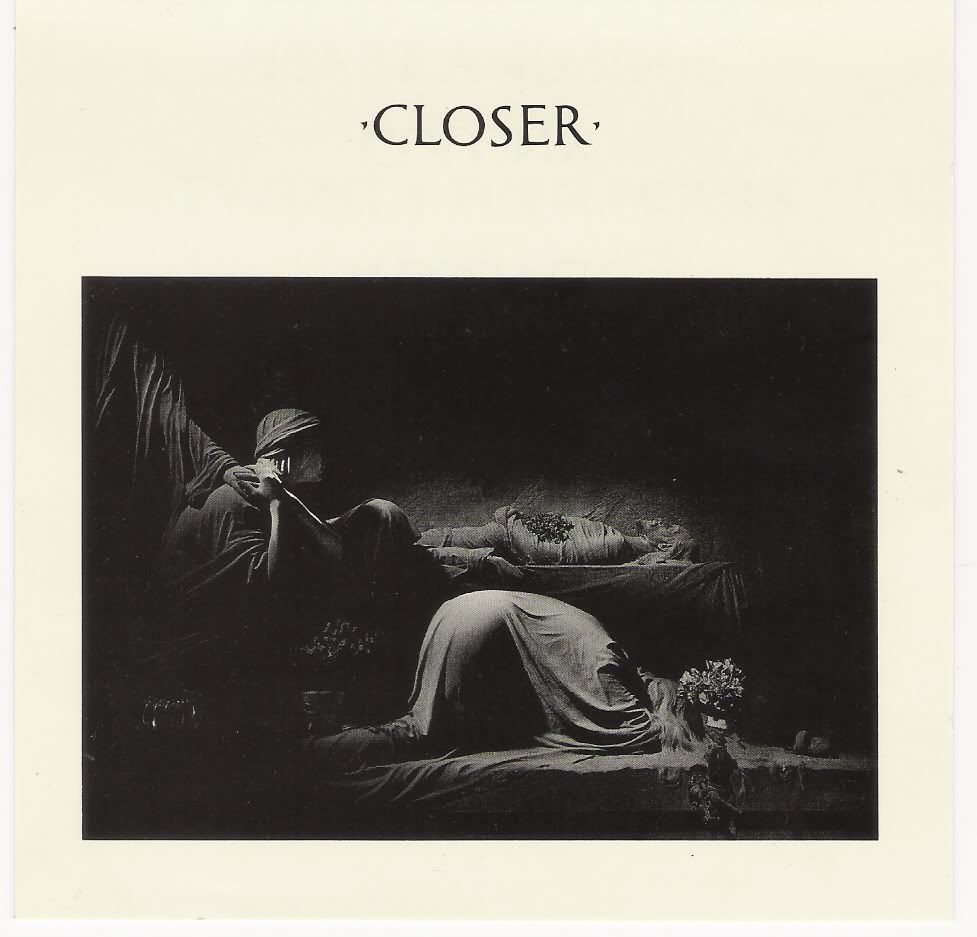
These are the first words ("Heart and Soul" from the album 'Closer') of Anton Corbijn's excellent movie about Ian Curtis, the frontman of the legendary band called Joy Division. And these words will be the key for the whole (life-)story too...

It is possible if Corbijn's name is already familiar to you. For me the Dutch was the most luckiest photographer ever. I remember I learned his 'strange' name as a teenager when I was reading music magazines like Metal Hammer as a Bible, and decided to be a photograph myself (actually I became). After Jonathan Glazer's and Spike Jonze's cinematic debut I was waiting for his unavoidable film the most. When I heard that he is working on a book of Ian Curtis' widow, I knew it's gonna be something real authentic.

"We're Joy Division. You're the crowd."
I was getting familiar the band relatively late. One of my friends gave me an LP (!) around the end of the nineties, and the unique sound didn't let me leave anymore. I'm not a music critic so my explanation might be rather funny: 'my' Joy Division contains a weak but raw guitar sound, a merciless bass, and a drum which sounds like hit on a pillow. And almost forgot: the whole thing is closed in a can:). Maybe Corbijn's pictorial definition is more accurate: he gave in his movie a mixture of Bowie, Iggy Pop and The Exploited. I suppose he has right with these impressions.

I don't know and actually don't care how real is the story or how faithful is Sam Riley's act in the role of Curtis. I know one thing: his performance is brilliant. His face is the saddest I've ever seen on the canvas. The R.E.M. clown Michael Stipe's arm-gestures are a joke next to his powerful marching-lurching stage presence. We'll see him again very soon I guess...


Some line earlier I said the word 'authentic'. Corbijn just continues the British 'free cinema' where Reisz, Richardson or Anderson left it some decades earlier. He found even a "new Malcolm McDowell" too:) Just compare with the JD's guitarrist from the film (James Anthony Pearson).


Ok, with my enthusiasm I could continue until the morning. Instead of that take my advice: go back in time to the early seventies to the grey English town, Macclesfield, turn the volume to the max, and sit front of your screen. Closer...

10/10

08 December 2007

Eastern Promises (2007)

Huh... There are films which keep you silent after the screening. There are two extremity: something is too bad or too good. You don't feel anything to say after this, but personally agree with those who almost cannot talk after Klimov's unbelievable Idi i smotri too. Luckily Cronenberg's new film is among the later examples.

I'm saying this despite I'm absolutely not a Cronenberg fan. For example – and now you can start to throw stons against me – the last piece (A History of Violence) from his auteur camera made me really disappointed. Maybe after the new one I will give another try to that one...

"Mom, are you okay?"
"Of course not, it's Christmas."
As you can see it doesn't start as a perfect family movie for Christmas. Actually if you don't like/bare explicit violence/blood/brutality, it's better not to watch (even outside Christmas-period). We are in present London, where the city's backyard full with immigrants who live their own life (everything is behind the touristic scenes of the city, there is only one sequence which refers to London how we know it). I almost said "who live their own life just like at home", but the film makes me sober and pulls me out from my convenient prejudices. The Russian maffia's boss gives the provocative statement: "I think London's blame for what Kirill is." The Western promises give false hopes for the people of the Eastern parts (of Europe). The image what it shows doesn't fit to the reality, to the "normal" reality of these people. They becomes whore or criminal because they are chasing some fake dreams, something which looks better than their former lives. The Western promises are responsible for all the processes which are happening today in Europe. The funny thing is that the Western countries are usually blame the Eastern immigrants because of their way of living, but don't realize that they make them who they are. The city's cultural pot makes some strange mixtures of human behavior, traditions and values. Cultural mutations.

Cronenberg's inquiry in these odd mutational mixtures is an old story. Common knowledge: usually he is interested in the different transformations of the body. Videodrome, Naked Lunch, Crash, eXistenZ,... I really don't need to continue. I feel this time he added a new actual value for these freak-shows: maybe first time he choose something acute, something which isn't timeless. We have the importance of the body here as well: meaningful tattoos, rape, murder, birth and death at the same moment, pulled out teeth, cutted fingers, freezed down corpses, and so on. But everything is embed into the chaotic intercultural "Now". Cronenberg doesn't need to slide into the sci-fi genre anymore, the reality in 2007's London lets his sick imagination look real.

By the way, realism: If you want to show some – for example Russian – authenticity, you don't need to travel East. Like some anthropologist, Cronenberg gives perfect view on the insane world of the globalized traditions. His characters are phenomenal (I hate this word's exaggerations, but this time...), at least the actors and actresses make these figures unbelievable true. If I say Vincent Cassel's language is more Russian than any of my Russian acquaintances, then what should I say about Viggo Mortensen's acting. He is just p e r f e c t! After this post I'm going to watch the scene again, where he defrosts (!) some unlucky dude. You have to watch it and forget all the poisoned background-interests about who and why will win the next Oscar prize...

Cronenberg is back (yes, I believe he climbed out from some crisis). I'm happy, and the sign of my enthusiasm is without any doubt:

10/10

04 December 2007

The Lady from Shanghai (1947)


Two post ago I told that Wong Kar Wai is planning to shoot a remake from Orson Welles' classic The Lady from Shanghai. That moment I realized that although I've seen Welles' film, it was more than 6-7 years ago, and almost didn't remember its plot. Of course you cannot forget the final sequence with the mirror room (already 10/10), but the rest faded away without trace...

Michael O'Hara's character is a classic figure, a simple and honest tough guy, who is getting involved in some higher power's dirty business. As he says: "some people can smell danger... Not me." The source of this danger is a deadly blond again, who is more dangerous than all the blond noir femme fatales together. Why? First Elsa's role played by Rita Hayworth (already 10/10), but if it wouldn't be enough, then I can tell you that she is that kind of type, who makes fool not only from an honest Irish sailor, but from you too. Beyond doubt.
By the way she is really like Laura Harring, alias Rita (Hayworth) from the Mulholland Drive...


The film is a huge setup with twists and turns, just watch this: Mr. Grisby wants Michael to kill Mr. Grisby. And for this favour he would be payed 5000$. By whom? You won't find out: by Mr. Grisby! (did I say already 10/10?)
The trial scene, the characters (sorry Rita, but my favorite is the Bobby Peru-like Glenn Anders as Mr. Grisby), the cinematography (the night scene on the boat is unbelievable), and Welles' genius screenplay and directing, and so on: everything is perfect.
After these what else, than

10/10

29 November 2007

Inland Empire (2006)


Enough. I'm fed up. It makes me really sad how the people are thinking about the "new" David Lynch movie. If you believe that a film equals with the story, this won't be your favorite. I say more: you don't need to watch it. Especially you shouldn't write about it: You don't need to prove your narrowness. To accept my advice is your interest, really.
I have only one wish: Please accept it if somebody (Lynch) is thinking in a different way as you. You should have already recognized that Lynch is not a narrative storyteller. If he is (The Straight Story) then he makes it very lurid. The exception makes stronger the rule...

Here is my contribution to this shallow discussion. Only for Hungarian readers.

Analysis, but at least an article about the Inland Empire in the filmkultura.hu, CLICK!

(The mistake with the footnote isn't my fault.)

10/10

21 October 2007

3:10 to Yuma (2007)


You have to watch it!
Actually knowing James Mangold's movies I expected this kind of quality. The "Identity" is one of my favorites, but Russell Crowe is pretty close behind Cusack's back. I haven't seen the original version (Delmer Daves, 1957), maybe after this enthusiasm I'll sacrifice another two hours for it.
I don't know how you feel, but for me Mangold's version haunted Zinnemann's "High Noon" (1952) all the time. Of course both are using the same deadline-narrative but there are more similarities, at least around how they build up their atmospheres. I can confess that I'm not a (big) western fan, that's why my keen words count double.
Bordwell has right (as usual): Mangold is coming from classic Hollywood storytelling with high attention to his characters psychology, playin with sudden shifts between sentiment and humor.
The eyes of Ben Foster shouldn't come into my dreams...


10/10