Showing posts with label youdecide. Show all posts

15 June 2008

Logan's Run (1976)


"Sometime in the 23rd century... the survivors of war, overpopulation and pollution are living in a great domed city, sealed away from the forgotten world outside. There, in an ecologically balanced world, mankind lives only for pleasure, freed by the servo-mechanisms which provide everything. 
There's just one catch: Life must end at thirty unless reborn in the fiery ritual of Carrousel..."

Another classic, but at least sci-fi cult film from 1976 (I mean from 2274:) by Michael Anderson about the possible future: at least in its above quoted prologue it encounters all our actual threat which might lead to the depicted utopia (the film definitely made influence on such movies like the Polish cult Seksmisja, but even Verhoeven's Total Recall or Bay's The Island). Our protagonist, Logan 5 (Michael York, who sometimes looks pretty much like Guy Pearce - see the pic) is a "sandman", a member of a special unit who are collecting and killing the so called runners, the ones who doesn't want to "renew" when they turn into 30.

"One is terminated, one is born. Simply, logical, perfect."

One day the 26 years old Logan gets a special mission: his superiors transform him 30 to create a runner from him in order to infiltrate and search for the secret place of the runners called Sanctuary. Why do they run? Why is it wrong to run? Logan's run is more a process of his awake, the realisation of the cruelty of their "well balanced" system.


After the first scene and the initial tune of the atmospheric soundtrack (omg Jerry Goldsmith was a genious! (he wrote the score for The Omen (best st. ever), Chinatown (or this would be the best?) from the same year, and later - not accidentally - for Totall Recall, too)) you feel Anderson's effort to make a "big" film; whish I could watch these classics on a big canvas...
Anyway, Logan's Run isn't a flawless film, for example the middle part is definitely longer than it should be, but if you're a sci-fi fan, then it is a real delicacy. Otherwise: you decide.

6/10

10 June 2008

The Oxford Murders (2008)

"Can we know the truth?"

Yes we can, and I'll tell you now - at least about Álex de la Iglesia's new movie, which fits to the series of the thousand times mentioned - and as I believe highly overestimated -  new wave of Spanish cinema (and where the best try is still Sánchez-Cabezudo's Noche de los girasoles!). Iglesia, just as the other directors from contemporary Spain has the knowledge about how to make movies in the new millennium. They especially mastering the style, the way how to build atmosphere and tension, but as far as I see they have obvious problems to tell an otherwise well chosen story. They want more than they can cope, their incontestable cinematic talent is just not enough to translate a well written material to the silver screen (see here mostly Amenábar).

Guillermo Martínez's book (Crímenes imperceptibles, 2003) seems to be too big byte for Iglesia. Sometimes what is working in written form does not the language of the moving pictures. Or we might have not the real film director. But what kind of story we have here to bear? The plot sounds simple: we have a serial killer in Oxford (to avoid spoilers I have to formulate my review like this). Simple as I said - maybe that's why had the author and the director the drive to make it complicated. And usually here lies the problem of all these movies: the necessary complication of the plot kills the real story, but what is more apparent, the wannabe complexity kills the way of storytelling, the reasonable logic of the narrative. And that's the real serial killing in these contemporary films...

Iglesia has another "wise" movie, which uses but more exploits all the merits, unsolved mysteries and eternal questions of mathematics, phylosophy, language theory, physics and who knows what kind of other sciences. It's kinda sad to see how these exciting thoughts serve an otherwise simple murder(ish:) story. I wouldn't say that I guessed right about the film's twisted end (at least 1 point goes for that), but my surprise doesn't mean that I enjoyed the outcome. On the contrary: if the very beginning of the movie cites Wittgenstein: "there isn't truth outside mathematics" - then I really expect something more hidden, unsolved, abstract ending than a clear and "aha" explanation what we finally got. Sometimes leaving something open gives more than close it for one single "truth". Chance is sometimes stronger than a sober logic. After all:

"It's always possible to find a rule, a justification which allows a series to be continued by any number. It all depends on how complicated the rule is."

To accept this otherwise undeniable rule is the problem with The Oxford Murders, and all the contemporary "wise" films.


5/10

06 June 2008

42nd Street (1933)

"Johns and Barry are doing the show!"

The classic 42nd Street about the 42nd street dance theatre at Broadway is Lloyd Bacon's film, but everybody knows because of Busby Berkeley and his stunning staging talent and dance choreographies. To know this you won't expect too much from the story - I bet 4 out of 5 movie fans are watching these films because of Berkeley and the damn good music from the '30s.

Thus if you expect some weak, subservient, shallow story you'll have a positive surprise: "It's a musical comedy with dancing" - says Julian Marsh, the obsessed production director (similar character as Roy Scheider's amazing Joe Gideon in Fosse's All that Jazz (1979)) in the film, but the whole is more than a musical within a musical. The story gives insight into the darkest years of the American great depression. The camera almost never leaves the music theatre, but within its walls, within the desperate effort staging a huge show in five weeks, explicitely emphasizing the weight of the show on people's lifes gives extra values to Lloyd's film.

As I said above the film is about staging a 'never seen before' show (Pretty Lady) with the beautiful Dorothy in the leading role. Not I'm the only one who admires her beauty: as it used to be, a rich but old and dumb fan of her sponsors the whole show, and I won't kill the joke if I tell you the source of the suspense: a former lover of Dorothy endangers this "perfect" cooperation between the show business and the sponsor's wallet...

Dorothy is a more than classic beauty of the '30s, but the real eyecandy is the way how the cinematographer (Sol Polito, see more from him here) and Berkeley created the visual style of the film. Actually the camera is training together with the dancers preparing for the show finale (carefully avoiding to show the most exciting angles and settings to reserve them until the end). Very brave camerawork from the lowest to the vertigous heights, optical tricks (sometimes the choreography is able to imitate these caleidoscope-like tricks (see the picture)), moderate cutting (the performances and the dances are more real / the viewer sits in an imaginary perfect position), and so on...


One more thing: Ginger Roger's "mistake" ("bel... tummy") can't be a mistake - see the revealing discussion about it here.
Even if it's a true masterpiece (within its genre!), you should decide about watch it or not yourself. I did and don't regret.

8/10

03 June 2008

Indiana Jones and the Kingdom of the Crystal Skull (2008)


I suppose you know everything about Spielberg's movie and familiarized yourself with all the film critics' opinions on Indy's new adventures, so here are my subjective feedbacks, right after coming out from the screening in telegraphese way:

1. It is not the "same" anymore.
2. Ford is too old to be Indiana Jones.
3. I'm too old for this movie.
4. Spielberg made a movie for children. I definitely need to re-watch the previous Indiana Jones films to see who changed more: Spielberg or me?
5. I understand and salute the efforts to make some old fashined CGI to serve stylistic continuity with the earlier films, but it is just doesn't work for me.
6. Speilberg shouldn't continue the series (He claimed that the fans wanted to have another episode. We know he was thinking about the box offices. I regret that I encouraged him with my movie ticket). The Indy-hat fits only on Ford's head...
7. The jokes were weaker than ever. Or see point nr. 4.
8. The action scenes were ridicuously too much - reminded me on the Mummy-shit.
9. I was happy to hear mentioning Marcus Brody. I wasn't for seeing Marion.
10. 10? No, sorry, this is only 6. At highest. And two points is out of nostalgy.

It's really hard to accept, but I have to say the Crystal Skull is a strong disappointment. The same happened with the late continuation of the Star Wars-series. It was ok, I had to watch them, but the feeling, the atmosphere, the "whole thing" is just not the same anymore. You might say that my complaints hasn't righteous, and probably you have right: during the couple of passed years I changed, the films changed, even the cinemas changed. But if you want to continue something classic, something cult, then you have to calculate with these changings too. And at this point Spielberg definitely failed. He just made the same professional movie as before. I hope you understand - but what I really hope, that Spielberg will understand this.

6/10

23 May 2008

Manufactured Landscapes (2006)

Very briefly about a very average documentary. Average in its way of showing a more and more average topic. About the massive transformation of a landscape, about the enormous-, even crazy architectural plans (the world's biggest dam on the Yangtze), about the exponential growing tendency of urbanization (Shanghai's terrible urban policy), about our energy footprints on the Earth's surface (the shipwrecked oil tankers at Bangladesh), ... about the unavoidable end of the world. Sorry, but I have to say it is already an average topic. You might be disappointed in me but I'm getting feel nothing special about this topic. I'm fed up how the American film directors and America itself are treating China. Because - of course - everything here is about China. About their terrible pollution, environmental politics, energy hunger, development spiral, and so on... Very traditional (average) story shown from a very traditional (average) point of view. As I said nothing's new. Like some broken recored.

But the biggest problem is not the average approach but something else.

Somebody should finally answer honestly the question: who made China as we can see now? Who is responsible for their "hunger"? Who showed them how to consume (we need a car, that's basic, but "Oh my God what will happen when all the Chinese wants a car too?")? It's kinda funny how the Western world is trying to plant some guilty feeling into China about their globalizational processes, about their sudden growth. Which is more funnier that everybody knows that these rhetorical techniques are based on our afraids on China's growing economical greatness and importance - which means their growing political influence. These are the real questions, not the didactical (average) pictures which are trying to emotionalize these absolute rational questions via showing some direct (average) parallels for example between the very rich and the very poor Chinese people.

These so called honest and brave documentaries usually forget to find answers to these questions in the background (I mean they even forget to try). They are satisfied with their surface pictures and cliché-dramaturgy. They are effective just like the director's, Jennifer Baichwal's pictures. This time a film about Edward Burtynsky, a photographer who "undercovered" the "truth", next time coming somebody else, and we will pucker our brows and give maximum points on the imdb just to compensate our own guilty feelings. 

I like the idea that we are frightened about the cheap Chinese products. "Made in China" is the devil itself. But we shouldn't forget that We, Europeans and Americans created the circumstances, we made the rules where China had only this chance to grow up next to us. We could label their country: "Made in Europe / USA." 
Somehow I liked the "sad" (average) but talkative pictures about the useless electronic devices which are poisoning the Chinese soil. A camera was panning on them where you could easily read on one of the wrecked panels: "Made in Holland." (see the picture) So, what we really talking about?


Average point for an average film.

5/10

01 May 2008

The Sniper (1952)

Let's start with a longer citation from the very beginning of the story - just because I haven't got too much to tell about this rather simple thriller from 1952.

"High among police problems is that of the sex criminal, responsible last year alone for offenses which victimized 31.175 women. Adequate and understanding laws do not exist. Law enforcement is helpless. Here, in terms of one case, is the story of a man whose enemy was womankind."

This offical-like depressive statement leads in Edward Dmytryck's film about a helpless man who starts to shoot women with his sniper gun. I could say that's all, because the story is so banal and actually doesn't happen anything more. Maybe one thing needs to be mentioned, his motivation which connects to the quotation above: he has built up hatred against women piece by piece, from which the story doesn't show too much. Mr. Miller is a deeply frustrated, misantrophe person already in a beginning who knows that he needs help (see other suffering, self-blaming serial killers like Spike Lee's almost perfect Summer of Sam (1999) or Fincher's perfect Zodiac (2007). The latter one's "zodiac" created puzzles in order to help the police to catch him - while Miller desperately honest with his letter: "Find me and stop me. I'm going to do it again."). Tragically his warning shouts don't reach his psychiatrist but turn into real gunshots. And he is unbelievable, I mean deadly accurate...

If you want to spend a simple but valuable 87 minutes I can recommend it, but I would say maybe it's better to watch - even if you've seen already - Dmytryck's timeless noir classic (again), Murder, My Sweet from 1944. The Sniper is nothing else as a straight thriller made sensitive for temporary social problems (the last frame's teardrop undoubtedly opens the individual tragedy to collective social dimension) of its age.


7/10

03 April 2008

Soom (Breath) (2007)

First of all maybe the most important information for those who haven't seen anything from Kim Ki-duk: This is definitely not the best film from him, instead of wathing this and decide about his qualities, please check for example Bad Guy, The Isle, Samaritan Girl, 3 Iron, or the latest Time. Actually I wanted to suggest my favourite films from Ki-duk, and it seems almost all of his are better than Breath. Your next question is: "Why?"

Look at the opening situation: Entering a prison in some South Korean metropolis' suburb. A convicted is scratching the wall with a toothbrush. Jang-jin grabs the tool and stabs himself on the neck. Suicide attempt committed by a condemned? Perfect Ki-dukian origo, especially when we meet a freakish sculptor woman with an unfaithful husband, who one cold morning decides to visit Jang-jin, who has been transported back to the prison from the hospital. She wants to cheer up the prisoner who is waiting for his execution. Now my question's turn: "Why?"

A possible answer would satisfies a narrative type of question, but known Ki-duk's interests we can assume this is not the right way to approach the "story" (it's coming out early that the woman was a former girlfriend of Jang-jin, but as a weak motivation points out immediately the unimportance of this meaning-searching). By the way, cheer up a condemned: that's the really horseplay, especially if it used for saving her own sunk family. Ki-duk opens up his well used kitschy narrative and visual elements to some absurd registers (the woman installs colorful wallpapers on the prison's wall and sings some song meant to be happy (actually listening to those I wanted to commit suicide...)), to earn some strange, baffling emotional mixture.

That's why we like the director, but not this time: maybe the biggest problem is that the story doesn't make any progress. I mean progress in a way how the earlier mentioned movies did. Maybe it's my mistake (I believe that Ki-duk's movies are very dependent on your actual mood, situation, context, feelings), but this time somehow the effect didn't work as it used to. Knowing his oeuvre I used to predict some really absurd twists in the stories, what Ki-duk even turns out through visual simplicity and astonishing banality. In Breath we have the well known layer-like visual stimuli, but the story cannot grow up to its colorful beauty.

I think I only could repeat myself. There were and will be definitely better than this, but it's still deserves six out of ten, which is only bad according to Ki-duk's genious uniqueness. (I almost whispered the word 'disappointment'.)

6/10

01 April 2008

We Own the Night (2007)

1988. New York, Brooklyn. We see original black and white pictures taken from the N.Y. police. Smooth trumpet ballad accompanies the photos. We are sliding into the soft eighties...
... but suddenly BOOM: neon colors, fat disco music (Blondie: Heart of Glass, definitely yeah!), and even fatter face of Joaquin Phoenix as Bobby climbing on Eva Mendes as Amada. I have to say that this scene is the strongest of the film.

Why I say this? Just take a quick look on the first five minutes of the movie! So we have Bobby, who runs the biggest and trendiest club, El Caribe in Brooklyn. The place is full with suspicious characters, the drog is in the air, but in the pockets for sure. The owner is a Russian fur-importeur (hmm, who believes this?), the family man Marat Buzhayev. Glittering, breath-taking party in the club.
...Fade in black...
Another party in Brooklyn. Dusty, smokey ballroom. The police is celebrating. The situation introduces all the characters in a second: Joseph (Wahlberg, again...) the honourable perfect cop, and his boss, Albert (Duvall, again and again...), who is - you won't find out - Joseph's father. Very original, but it's still nothing: of course Bobby is another son of the police chief, as Joseph's brother. And you know all these infos within the first 5-10 minutes. Didactic situation? Classic drama of oppositions (haha, the producers are Wahlberg and Phoenix)? Professionally tight story-establisment? You can decide, but one thing is sure: no one can compress as much clichés into such a short storytime than the director James Gray (no, he is not F. Gary Gray).

Maybe no need to go into more details about the story, just for safety: the police wants to catch the Russians, who "must something to do with the drug on the streets", and Bobby looks very good for the role to infiltrate into the family...

I won't continue not because of killing the points of the film (if you are more than 12 you know already what will happen), but to answer the question above (if I didn't do already..). The biggest problem is with Gray's film that it lacks any kind of originality. I mean it is really disturbing how predictable it is. Departed (which is as we know already a copy), American Gangster, L.A. Confidential (the best within the genre) and so on, just pick out examples among the very well known ones.

We Own the Night is a weak (the acting is terrible, the worst example is Danny Hoch in Jumbo's role, he is ridiculous), but at least mediocre copy, even it was predictible that these kind of clone-films will flood the cinemas.
Average film - average entertainment (even the feelgood music and the desperate search for atmosphere (see the effort of accuracy of the WTC towers' soft presence..) couldn't help) = usually 5 points, but "thanks" for the unbelievable waste ending even minus one.


4/10

20 March 2008

The Rocky Horror Picture Show (1975)

[I still don't have the definition of the cult movie, but I'm working on it...]

"I would like - if I may - to take you on a strange journey" - says some odd narrator-like criminologist holding in his hand a case-book of "The Denton Affair". Yes, the movie is about a couple, Brad and Janet (by Susan Sarandon), who left Denton to visit Dr. Everett Scott (or Dr. Everett von Scott!...) in the middle of the night on a late November evening. But a huge storm crossed their way and aims, and they had to find help in a remote castle, where the "Annual Transylvanian Convention" was held. The place is full with strange characters, but the most weird is among them their leader, Dr. Frank-N-Furter, a transvestite from the transsexual Transylvania (don't ask why is the latter part of the syntagma, the reason must be some sick alliteration). Anyway, they are partying quite hard, involving the couple (for me Sarandon is the real monster with her scary huge eyes...), and creating a Frankenstein-type muscle figure called "Rocky Horror". (He isn't the scariest: my personal favorite is Riff Raff, the boss' hunchbacked servant (played by Richard O'Brian, the film's music- and screenplay writer), who's voice was later imitated by Dr. Evil from the Austin Powers series:).

Ow, I almost forgot: the film is a musical (btw you probably knew this important detail even if you haven't seen the movie - see my missing definition of the cult...). It means - what a surprise - they are singing. A lot. I mean they are communicating with each other mostly through songs. Just like you've seen in the new - mostly overestimated (by me too) - Tim Burton film. Actually it is perfect to compare these two films, ...because they are so different. The Sweeney Todd's best parts are when they are (Depp and Bonham-Carter) not singing - and Jim Sharman's RHPS's big moments are when they are. Burton's movie as a musical is a failure, Sharman's musical as a film either.

It seems I don't like the musical-films or film-musicals. But listen, here comes my real point: Have you seen Brian de Palma's Phantom of the Paradise, which was released ONE year earlier than this famous-cult (grrr) Rocky Horror PS?? If not, you should immediately! That is the movie which deserves all the appreciation and cultic status what the latter one owns. But as our heroes say: "Madness takes its toll" - it seems even in our taste and film historic honor as well.

To summarize: if you're Susan Sarandon's fan, you should watch it (let's say she isn't "overdressed") / if you want a real horror show you shouldn't (but doubtless de Palma's film) / if you like musicals you should (the music is really ok) / if you have expectations coming from its cultic fame (>†π#@!), you definitely shouldn't / in one word: this time you decide.

but at least I warned you: "Don't get hot and flustered, use a bit of mustard!" :)


5/10

17 March 2008

Á l'intérieur (Inside) (2007)

Bloody hell! And almost literally...

Some post ago I confessed that I'm not the biggest fan of the new Spanish horror-thriller stream. They are mostly stylish, wannabe shocking directors with sterile, ephemeral look. If you feel the same but still hungry for a real shocking experience, it seems you need to visit another country. I'm getting more and more convinced that France produces the most disturbing movies in our age. The warning sign was released by Alexandre Aja: he was only 25 when he shot the memorable Haute Tension in 2003, which was followed by David Moreau's and Xavier Palud's Ils (Them) in 2006. Those were definitely scary, but what I've just seen...
Now here we have another French duo: Alexandre Bustillo and Julien Maury made something really special, something really ................ (find a good expression which covers 'brutal', 'disgusting', 'scary', 'disturbing', 'bloody', 'terrible', 'sick' and so on!)

The "story" is quite simple. We have a pregnant girl, Sarah who suffers a car accident. Her boyfriend dies, and now she is living alone in an apartment (with a small black cat, what else..). Expecting a baby. Alone. The night before the childbirth a scary woman knocks on her door. She knows Sarah. She is not coming with empty hands: she brings your worst nightmare to the house. And a huge scissors too, of course... (After this I was sure already that Beatrice Dalle isn't 100%, this actual role is only my confirmation:).

Bustillo and Maury know a lot about film history. They are comfortable with any slasher or gore elements, but what is even better, they are familiar even with the art house as well. Antonioni (Blowup), the early Polanski (Repulsion, Rosemary's Baby), Haneke (Funny Games) are among the referred masters, depends what the story needs at a certain moment. During watching even a Japanese movie popped into my mind too: if you've seen 2LDK, then you know why:)
And here is the necessary weak point: as it used to be, the spilling blood flushes away the plot. Motivations, characters are subordinated to the arteries and other splashing organs (I know that some of you will like it especially because of this. "It can happen anytime, anywhere, without any particular reason" - But exactly that's why I believe that the "reason of the violent massacre" as a motivation is weak OR useless).

Usually I would give a tag 'watch it', but this time I need to warn you with a 'you decide' one. I'm not joking: it's really not an easy piece (see the dots above...). And one more serious advice: If you're expecting a baby you should forget it immediately.
Have a nice dream for me tonight... I hope at least.


7/10

02 March 2008

Die Fälscher (The Counterfeiters) (2007)

"Earning money as an artist?
Earning money with printing money is quicker. It's a shortcut."

1945. Monte Carlo. The WW2 is just over. A silent, mysterious man arrives. Loaded with money. A lot of money.. The camera / our view blocked for a second and suddenly we are in 1939. Berlin. Because the story, I mean The Story starts then and there...

A story which tells about the Jews, concentration camps, cruelty and humanity, Nazis (cruel and human, too, of c.) throught all the already seen stereotypes. The Austrian Stefan Ruzowitzky's – Oscar winner(!) – film doesn't show anything which wasn't shown before. His Counterfeiters doesn't do more but counterfeits the cinematically well known topic.

Terrible soundtrack, very bad acting, mediocre cinematography, almost original story. It's getting better, isn't it?:) What's original in this thousand times played situation? Maybe the Devil's circle in it. The agreement between the counterfeiter Jews and the Nazis in the kz lagers. As long as they support the Nazis with their counterfeited pounds and dollars, the war is sponsored and goes on against... the Jews. As long they won't make the banknotes, the war will be over, but then they won't be useful for the Nazis anymore. I said 'deal' – I wanted to watch it. As I said the story gives a good frame, but what's inside has nothing to do with originality or filmmaking in 2007.

This year the Oscars went quite good hands. The Coen brothers and PTA for his epic masterpiece received what they deserved. And then coming this film as the best foreign movie. It must be a really bad joke from America to claim that The Counterfeiters is the best non-American film. It's degrading to compare this against their truly good ones this year. Everybody knows (ok, except the Academy) that the best foreign (non-American) film from 2007 is Mungiu's embarrassingly perfect 4 Months, 3 Weeks & 2 Days (wasn't nominated at all). But I suppose it was written several times, several places.


"I'm not giving the Nazis the pleasure, of feeling ashamed, to be alive."
I'm not giving Hollywood the pleasure, of feeling stupid, to be proud on this.

5/10

01 March 2008

Into the Wild (2007)

I could write really long this time, but I won't. I could write a lot about this movie to prove it how temporary are its values. But I won't because it doesn't deserve it.

The funny thing is it hides its ephemeral existence with a layer of universalism. It "tells" about the big powers of mankind, society and the original values of nature and Earth. It even uses a true story to earn dramatic sideeffects via the shown "reality". But I have to wake you up from your emotion-driven amazement to point out the real aim of this film. Actually I believe you realized yourself too that this film is a political statement of Sean Penn. It's nothings problem with his view and criticism on things of today (Bush followed by Bush), but I'd like to remind everybody that we are talking about a movie which exploits the above mentioned big values to order of its real propaganda. And that's not so nice..

"Money makes people cautious." Right, it must come from the Devil:) "Career is a 20th century invention." That's stupid, but the main idea is coming through. The elder Bush is on the tv about the neccessity of war. Understand it. We know Penn's arguments for a while, and I said it's ok, actually I agree with him some extent. But what I don't like is to use a real and actually beautiful story of Christopher Johnson McCandless to argue about this temporary shit around us. Because I'm sure that McCandless made his "breakaway" in the early nineties from the society to forget all this ephemer, petty political circus and the whole "hype" around it delivered by the so called society. I'm sure he never wanted to be a protagonist of a film, especially not in that one which exploits his character in order to force through some temporary message.

Next to this ethical question the biggest problem of this film is its demagogy. It formulates its real aims too obvious. I know if you want to deliver a successful propaganda you shouldn't need to be too complicated and indirect. But then don't be surprised if the protagonist draws the conclusion right into your face: "Happiness is only real when shared." McCandless needs to die to prove us: if you leave society you won't solve the problem. You need to change the world around you. Actively. Now.
That's what I call disgusting demagogy (Of course the film landed within the best 150 film ever made on the imdb. Ridiculous. America's conscience through the small stars).

Kerouac, Rousseau and now this poor McCandless are turning/disturbed in their graves. They are used for something they never wanted to express. How his diary says? "Ultimate freedom. No phone, no pool, no pets, no cigarettes." That's right, but then no politics either please.
Shame on you Mr. Bush. Shame on you Mr. Penn.

3 stars for the soundtrack by Eddie Vedder and 2 for Emile Hirsch who is really getting better and better actor.

bonus: pictures of McCandless' real and the film's "magic bus":


5/10

27 February 2008

Thirty Two Short Films About Glenn Gould (1993)

Strange coincidence? First a bloody musical from the Fleet Street, then a videoclip-like Daft Punk vision, and now I have another music-related movie, this time about the eccentric Canadian piano player, Glenn (Herbert) Gould. Or even 32 short films? The title is honest: the film delivers thirty two small pieces from a complex character.

"I didn't want to reduce [him] to one dimension." – said Francois Girard, the director, so he made 32 dimensions, which is six times more how Todd Haynes did last year with Bob Dylan. The idea is the same, but the movies are quite different. Here we have fragments of a character through different genres. Dramatized situations, interviews, animation (by Norman Mclaren!) and experimental stuff. 


I've choosen to watch this film not because of Gould, but because of its form. Reading Louis Giannetti (1999, 137) you're getting curious: "The movie's structure is not a straightforward narrative, but series of fragments, loosely based on the thirty-two-part Goldberg Variations of Johann Sebastian Bach – one of Gould's most celebrated virtuoso performances. The film is structured around ideas rather that a linear story, and for this reason, thematic montage is its style of editing." Since I'm interested in every kind of non-linearity in narratives, it was a logical step to watch Girard's film. And the decision was good: Giannetti had right, my interest was fullfilled, but...

... it would have been around twenty stories enough. Let's see: 
Twenty Stories About Glenn Gould.
Sounds better isn't it? 
I can repeat what I said after watching Electroma on the other day. Even if this is a definitely better try with thick atmosphere around its protagonist's odd personality, better listen Glenn Gould than watch.

By the way, how would you picture the music?


7/10

23 February 2008

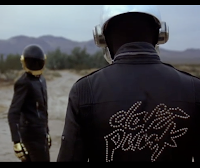
Daft Punk's Electroma (2006)

A small disappointment for the weekend. I was searching for this special film a lot, finally found it, but after watch it I'm not happy at all.

At first: Why it is a special one? After this week's booooring arias sung by Sweeney Todd I wanted to prove myself there are good ones which are using a music in peculiar way. Moreover Daft Punk is one of my favorite bands so everything was given to have a nice compensation after Burton's musical. It seems I'm gonna stay with the new film of the Coen's which deliberately refuses every kind of diegetic or extra-diegetic music...

Don't misunderstand me, there is nothing wrong with the music here. But only a small remark: there isn't any DF music during the 80 minutes. The "story" (the thematic?) is more from them than the music, which sounds closer to the other French duo's, the Air's world (from Haydn to Sebastien Tellier).

A pro pos story. The first scene: We have two robot-like guys, who are getting in an oldish black cool sportcar, and start to eat the miles under the sunny Californian sky. Looks like a road movie, and it is, according that it used to be that the heroes (here are Robot Heroes as the credits say) are hiding or searching something. Here it seems the latter case: they are desperately searching the ways to be 'Human' (yes, the licence plate of their car..). Anyway, I could tell more (wouldn't last too long), but it's just not worth according to this definitely non-narrative film. Then what else? Good question.

During the sterile movie's 70 percent the two robots just walking. I bet more than Irimiás and Petrina in Béla Tarr's more than 7hrs long Sátántangó (Satan's Tango). Ok, there is nothing's wrong with this one if they arrive somewhere, ... somehow. But - sorry that I'm telling you - they aren't.

Let's look at it as a video clip. It's a bit long this time, a Daft Punk without DF music, but at least you gonna learn how a robot can destroy itself if cannot reach its self-destruction button.
If you're a Daft Punk fan maybe shouldn't watch it. If you hate those guys (Thomas Bangalter & Guy-Manuel De Homem-Christo), it's really something for you to collect better argument against the fans. Better listen to them than watch.
5/10

14 February 2008

Chambre 666 / Room 666


Don't be scared, it's not another bloody horror flick. But I admit it sounds like some satanic ceremony or I don't know, and even the "soundtrack" keeps up this first impression of ours...

So it's not a horror film, not even a feature one but a documentary. The first in this blog. Briefly: it's a documentary about "the future of the cinema". The question was taken by Wim Wenders, in May 1982 during the Cannes Film Festival in a hotelroom (you'll find out its number). The answers are coming from the directors who attended that year at the festival. Some of them disappeared already (their future is already answered..), some of them made a cinematic fortune.

"The future of the cinema". It's a typical Wenders-type question. Let's see the answers. Don't forget, we are in 1982!

Who else than Godard starts, who predicts "more and more movies look like tv series." Nice shot, but I would say the "future" brought exactly the opposite. At least in 2008. Besides his train of thoughts actually he is more interested to watch a tennis game (oh, Roland Garros, 1982) on the television, which is the best answer of the forced question:))

Monte Hellman (A Fistful of Dollars together with Leone) is coming: "I think that the last few years have been a bad period. I think that there haven't benn a lot of movies that I cared to see. And the ones that I've seen I've been disappointed in." Typical attitude toward the the contemporary cinema: everybody has a nostalgic feeling about the past, and this feeling works if we are talking about movies, too. But hey man, you're talking about the best years of the film history, about the seventies! No comment, go further.

Next to others Noel Simsolo is coming (never heard of him, maybe you? check): "It's not the cinema that's dead, it's the film-makers who make moronic films." He is really angry, after this sentence turned off the camera. What a primadonna..

Finally a real character! Fassbinder looks like some homeless truck driver, but his words are the winner. What is he said? I won't tell you: even a documentary might contain spoilers:)

Actually Herzog is on the ground, too. First of all he claims that he cannot answer this question with his shoes on. Haha, I'd like this answers on these questions... Above these he seems to be the best futurologist among the directors: he fantasizing about video cameras with which you can shop, take out money, or order food. After yesterday's news from Japan it's quite a good shot into the future. His summary about the pessimistic question is optimistic and funny: "What is the difference between the tv and the cinema? You can turn off the tv, but not the cinema." I like this.

Here comes the most optimistic one: How Spielberg is answering the question about the future of cinema? Of course he is talking about money. E.T. has eaten 10 million Dollars in 1982, and he believes that these costs will raise in the next years. Good guess, but I'm quite sure he was never thought about Spider Man 3's around half billion bucks...
The funniest part when is talking about the connection between film and audience. He believes that the people doesn't want to see some character who "masturbate for the first time at 13, whatever." Instead of that "You know, I want a picture that's going to please everybody." I accept this ars poetica, especially if the Indy4 will be as it looks like...

The next one is Antonioni. Strange to see him walking around, full energy. Anyway. His thoughts are quite sober: "The change is inevitable, and we can't do anything to prevent it. We will only have one thing to do: We will need to adapt." Wise and calm as his beautiful movies are.

That's all. Just one thing: this 45 minutes film has something like five points on the imdb. Maybe doesn't deserves more, but I'm quite sure that how the years will pass the ideas and the whole situation of this documentary will be more and more valuable but at least interesting.

7/10

03 February 2008

Cannibal Holocaust (1980)

"What you will see will definitely shock and offend you." – Written on a black screen immediately, and I just agree. Ruggero Deodato's terrible, disturbing "classic" or at least "cult film" (btw somebody should tell me the exact difference between classic and cult..) isn't a typical Sunday evening entertainment. To tell the truth I believe this is a disgusting crap. Ok, don't bite me (...), I agree, I don't know anything about every kind of snuff trash shit moviemaking, but I have to say I don't regret. And if you think this is a masterpiece, then you have serious problems.

I know exactly the values of this film, actually they are pushed into our faces. Let's see them through the story: A team of documentary filmmakers disappear in the deep jungle of South America ("Only few hours from our homes") during filming and searching for real cannibals. Professor Harold Monroe, an anthropologist from New York is going to rescue them but returns home only with the recorded material. The footages contain terrible stuff. Terrible in two ways: how the filmmakers were treated the nature and the cannibals (yep, understand, we aren't different than the primitive ones), and how the cannibals were treated them... That part is disgusting full with extreme violence and cruelty, don't need more explanation, here comes the "cult" adjective.

And we are cannibals in our big city jungles too (the shot which pans from the trees in the (Central?) park to the skyscrapers is perfect). A tv channel wants to edit the recorded footage and broadcast as an anthropological film under the title: "Green Inferno". Monroe's condition: they need to show the whole material. So, together with the execs we are lucky enough to see the "uncut version"... Do I need to mention again how disgusting is it?

Finally about the film's reality or documentary values. There are really stupid legends in the film history and here is another one which tries to uphold the idea about the Cannibal Holocaust's (what a stupid, sensationalist title) realism. I mean according to the found footage, the way how Herzog's real (?) documentary compiled about the Grizzly Man, or how The Blair Witch Project turned the documentarism into PR money. If you have seen the film (and not only talked about it) you should see the beginning with the honest credits – included the story and screenplay writer's name (Gianfranco Clerici). Ok, I've seen the joke at the end about the mysterious John K. Kirov, who sentenced to jail because of trading with the film, but come on..:)) Anyway, if you eat this bullshit, just click here, and be happy.

And why I give 4 points? At least one goes to Riz Ortolani, whose music is an undoubtedly perfect score. It would work for a b porno in the 70s too, but its airy melodies mixed together with the bloody brutality is just phenomenal, but at least quite effective here as well. Better listen than watch!

4/10

20 January 2008

The Brave One (2007)


"Someone is playing God out there..."

There is a commonplace idea: if you lose somebody who is important to you, you lose a part from yourself, too. You become a different personality. This is the origo of Neil Jordan's (The Crying Game, Michael Collins, Breakfast on Pluto) new film. Not the most original idea, which means the film should have extra values to explain this simplicity.

I won't sell any spoilers to uncover the start of the diegetic situation. Erica (Jodie Foster) and David (Sayid, I mean Naveen Andrews) are the happiest couple in New York (I hope my irony is coming through. just imagine them:)), until one night they stuck in a brutal gang. After some squabble they were beaten by the cruel hooligans. David dies, Erica becomes the most charlesbronsonian "vigilante supercunt" (not my words..), some champion of justice who cleans the dirt from the city. Wow, that's all. I haven't seen such an original plot before..

So where are then the cinematic excuses to use such a simple story? Maybe the embarrassingly obtrusive "background meaning" with all the American frustration (9/11 indirectly and Iraq literally), maybe Foster's acting (ok, it was a joke), maybe the style of the movie (the wobbling, spirally moving, slowed down camera doesn't create art, rather boredom), maybe the tiresome Hollywood-criticism (while the gang is recording their deadly attack they shout "Hollywooood")?
I don't know. One thing is sure: if you're interested into these topics, this kind of mixture of style, meanings and interests you better watch any Spike Lee's joints (the most relevant is the 25th Hour).

Because what you can do with Foster's "T-shirt-message" (from bee to eagle) or with such a conversation:
"You shouldn't smoke. It will kill you."
"I don't care"
Pff, come on, it's 2007...

By the way to criticize Hollywood is your choice, but then please don't give an end of your movie like this. It meant to be a happy end, but I wasn't at all...
6/10

14 January 2008

Before the Devil Knows You're Dead (2007)


Big director, big expectations, mediocre movie. Sidney Lumet was – and I believe is still – better director than this work. I mean nothing is wrong with the film, but that is the best what I can tell you about it. We have a perfect non-linear story (1 step back, 2 forward), unavoidable twists, tricky overlaps in the plot, chilly tension, drama and even / finally Marisa Tomei's boobs  on the screen (I won't copy here – the net is gonna be full with them soon..). But nothing's more, and it's just not enough from a director who is responsible for The Pawnbroker, Equus, Serpico, 12 Angry Men and so on...

By the way if we are talking about breasts: if the uniqueness of the story, or Ethan Hawke's forced and overacted play deserves zero point then Philip Seymour Hoffman will save the day (even he has definitely bigger tits than Tomei's). His entrant is quite ... how I should describe it ... "powerful" already and it's just going better during the film (in addition he has my most wanted car too). He is one of my favorite actors after the Happiness. There he was a traditional prick, but here is such a prick, who thinks he is the king of the pricks – and he thinks right without a doubt:) He even admits it:

"You're a prick, Andy"
"I always was" (– replies with the most ... prickiest (?) smile)

But this movie isn't funny at all. Everybody knows the story (only infants shouldn't read further). Two brothers (Hawke and Hoffman) going to make a "mom and pap" operation: their plan is to rob their parents jewelry shop to earn money (wow) and even more from the insurance. I think the Coens at this moment would stop to read further the story...
The film is about the antecedents and consequences of a crime. What else? Whatever.

6/10